
Norway With a Dog: The Tapeworm Timing Trap Before You Cross the Border
Norway looks like the perfect dog trip.
Fjords. Forests. Mountain roads. Cabins. Fresh air. A dog staring dramatically into the distance like he personally discovered Scandinavia.
But before your dog becomes a tiny wilderness philosopher, there is one rule that can ruin the whole plan:
Norway usually requires dogs to have tapeworm treatment before arrival.
Not “sometime before the trip.”
Not “when you remember.”
Not “at the border while Noodle negotiates with customs.”
The timing matters.
For many dog owners travelling from the EU or EEA, Norway is where the normal pet passport checklist gets an extra step. You may already have the microchip, rabies vaccination and pet passport. That is good.
But for dogs, Norway can also require treatment against fox dwarf tapeworm before entry. Info Norden says this treatment must be administered by a veterinary surgeon 24–120 hours before arrival in Norway, with exceptions for dogs imported directly from Finland, Malta or Ireland. Frequent travellers may be able to use the 28-day rule.
That is the trap.
You do not just need the treatment.
You need the treatment at the right time.
Rasel would put it in the calendar.
Noodle would say, “I ate grass yesterday, does that count?”
It does not count.
Quick Answer
Yes, many dogs travelling to Norway need vet-administered tapeworm treatment before arrival. The treatment usually must be given 24–120 hours before entering Norway and recorded correctly in the dog’s travel documents. Dog owners should also check microchip, rabies vaccination, pet passport, customs channel rules, Sweden-route exceptions, breed restrictions, rescue/former stray requirements and Norway’s leash season.
Why Norway Is Different From a Normal EU Dog Trip
Norway is in the EEA and Schengen area, but it is not an EU member state. For dog owners, that means you should not treat it like a casual internal EU hop.
The basic pet travel pieces still matter: ID marking, pet passport or correct documentation, rabies vaccination, border presentation and dog-specific parasite treatment.
Info Norden lists ID marking, an EU-approved pet passport, rabies vaccination and tapeworm treatment among the requirements for travelling with dogs, cats and ferrets from the EU/EEA to Norway.
Norwegian Customs also says dogs, cats and ferrets must be identified by microchip or a clearly readable tattoo, and that animals normally need rabies vaccination. It adds that dogs usually need treatment against fox dwarf tapeworm, unless they arrive directly from certain EU/EEA countries considered free of the parasite.
So the big lesson is simple:
A pet passport is not the whole checklist.
It is the folder.
The tapeworm treatment is one of the pages that must be inside it.
The 24–120 Hour Rule
This is the part to build your route around.
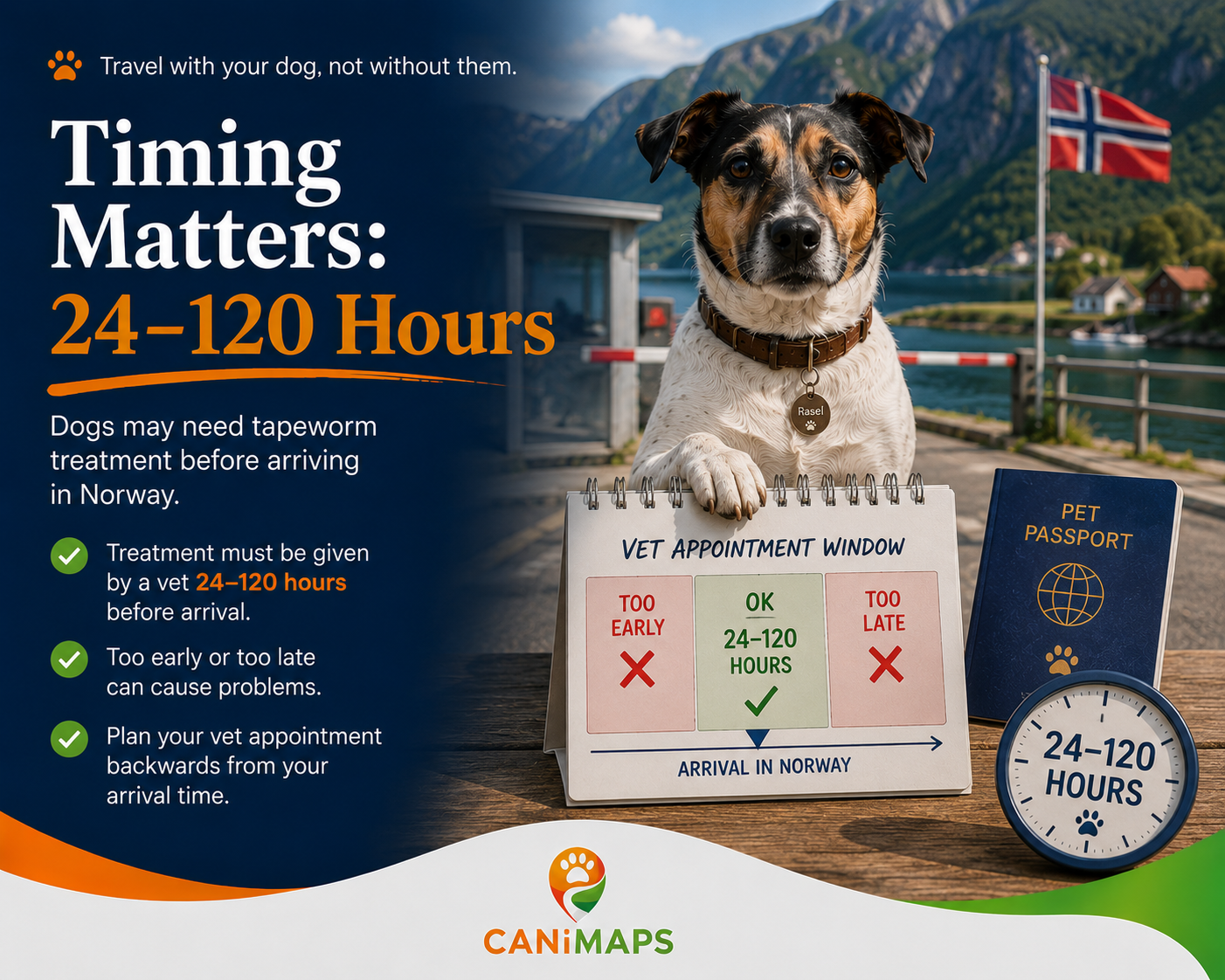
If your dog needs tapeworm treatment, it must be given by a vet within the correct window before arrival in Norway.
Info Norden states that all dogs travelling into Norway must be treated for fox dwarf tapeworm, with exceptions for dogs imported directly from Finland, Malta or Ireland, and that the treatment must be given by a veterinary surgeon 24–120 hours before arrival.
Translated into normal travel panic:
Too early can be a problem.
Too late can be a problem.
“We will find a vet on the road” can become a problem.
“The ferry is delayed” can become a problem.
“Noodle ate the appointment card” is not a legal argument.
The safest planning move is to choose your Norway arrival time first, then book the vet appointment backwards from that time.
If you plan to arrive in Norway on Friday afternoon, do not just book “a vet sometime Monday.”
Count the window.
Rasel: “We arrive Friday at 15:00.”
Noodle: “I arrive emotionally whenever snacks begin.”
Rasel: “That is why I handle documents.”
The Treatment Must Be Documented
Do not think of the treatment as just medicine.
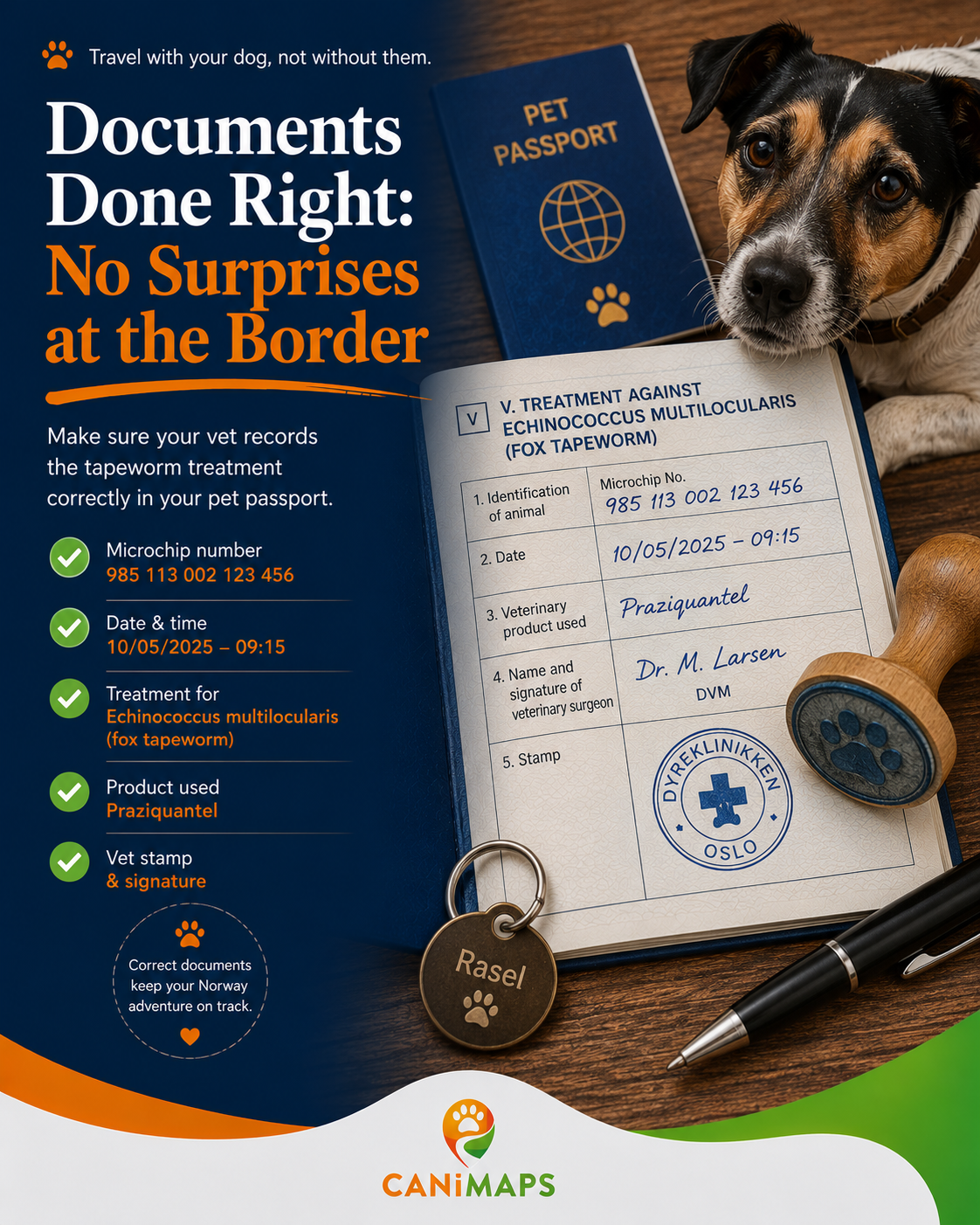
Think of it as medicine plus proof.
The vet needs to record the treatment correctly in the dog’s travel documents. Border staff are not reading your dog’s vibes. They are checking paperwork.
Before leaving the vet, check the dog’s microchip number, date and time of treatment, product used, vet stamp and signature, pet passport entry and your Norway arrival time.
This is boring.
Unfortunately, borders are powered by boring.
Do You Have to Use the Red Channel?
Usually, yes.
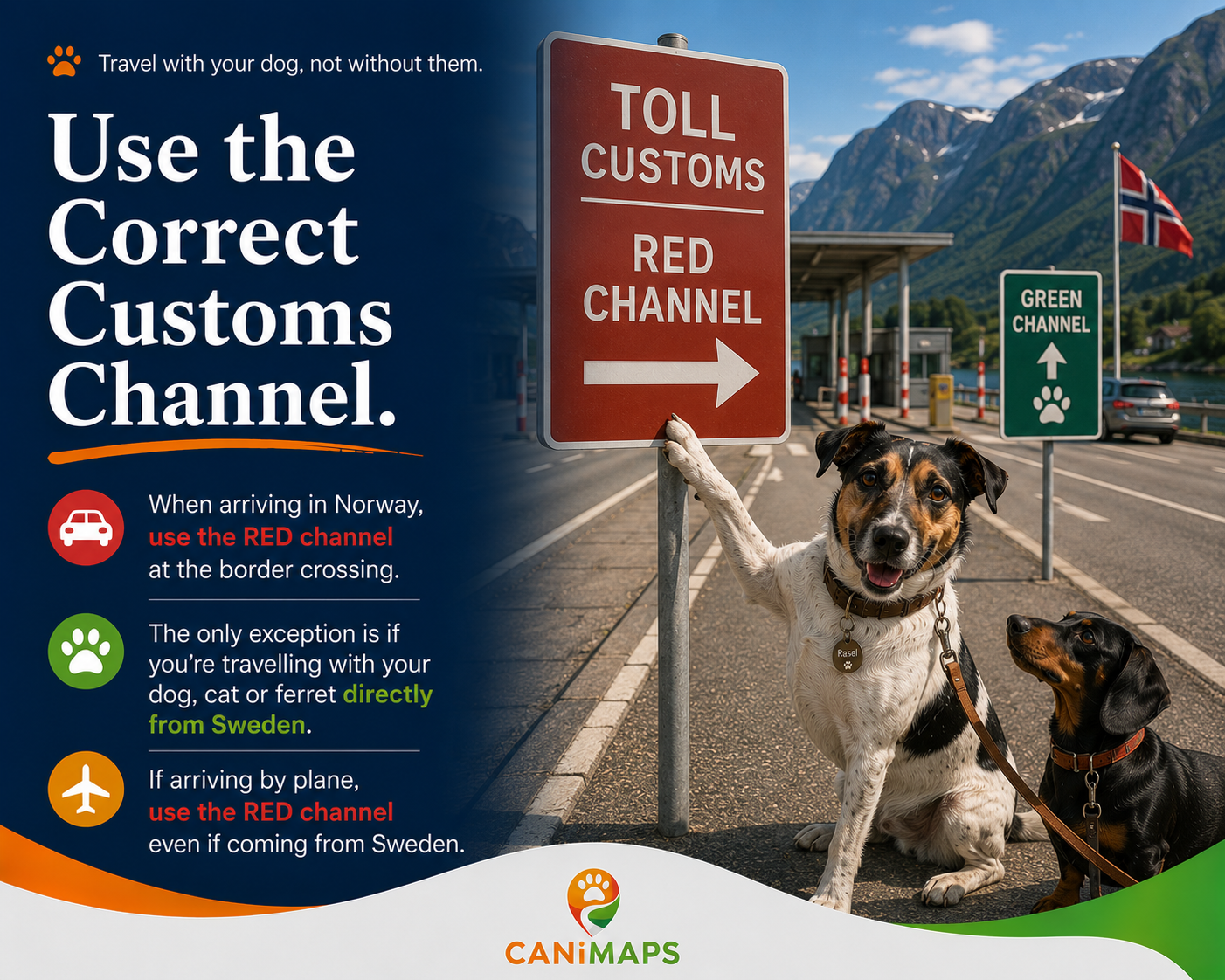
Norwegian Customs says travellers must always go through the red channel when entering Norway at the border crossing, except for people travelling with a dog, cat or ferret directly from Sweden. If arriving by plane, Customs advises using the red channel even if arriving from Sweden.
This is one of the easiest details to miss.
You may have nothing to declare except one small dog with a big personality. But that dog still needs to be presented correctly.
Noodle would choose the green channel because it matches grass.
Rasel would choose the red channel because he read the page.
Be Rasel.
Sweden Is Not the Same as “No Rules”
There is a Sweden-related exception, but do not turn it into a myth.
Norwegian Customs says the exception to the red-channel rule applies to people travelling with a dog, cat or ferret directly from Sweden; it also says animals that only travel between Norway and Sweden are normally exempt from rabies vaccination.
But this does not mean every Sweden-shaped route is automatically simple.
You still need to check where your dog started the trip, which countries you entered before Sweden, whether the dog is travelling directly from Sweden to Norway, whether rabies rules apply to your full journey, whether tapeworm treatment still applies and which documents you must show.
This is especially important if you are doing a road trip through several countries.
Borders care about actual routes, not vibes.
Frequent Travellers: The 28-Day Rule
If you travel often with your dog in the EU/EEA, there may be another option.
Info Norden says frequent travellers can treat the dog continuously against the tapeworm parasite with a maximum interval of 28 days, known as the 28-day rule.
This can be useful for people who cross into Norway regularly.
But it is not a casual shortcut. You need correct veterinary timing and documentation. Missing the interval can break the chain.
In other words:
The 28-day rule is not “I treat the dog monthly-ish.”
It is “I have a documented schedule and I respect it.”
Noodle hears “monthly-ish.”
Rasel hears “maximum interval.”
Again, be Rasel.
Breed Restrictions Can Be Trip-Ending
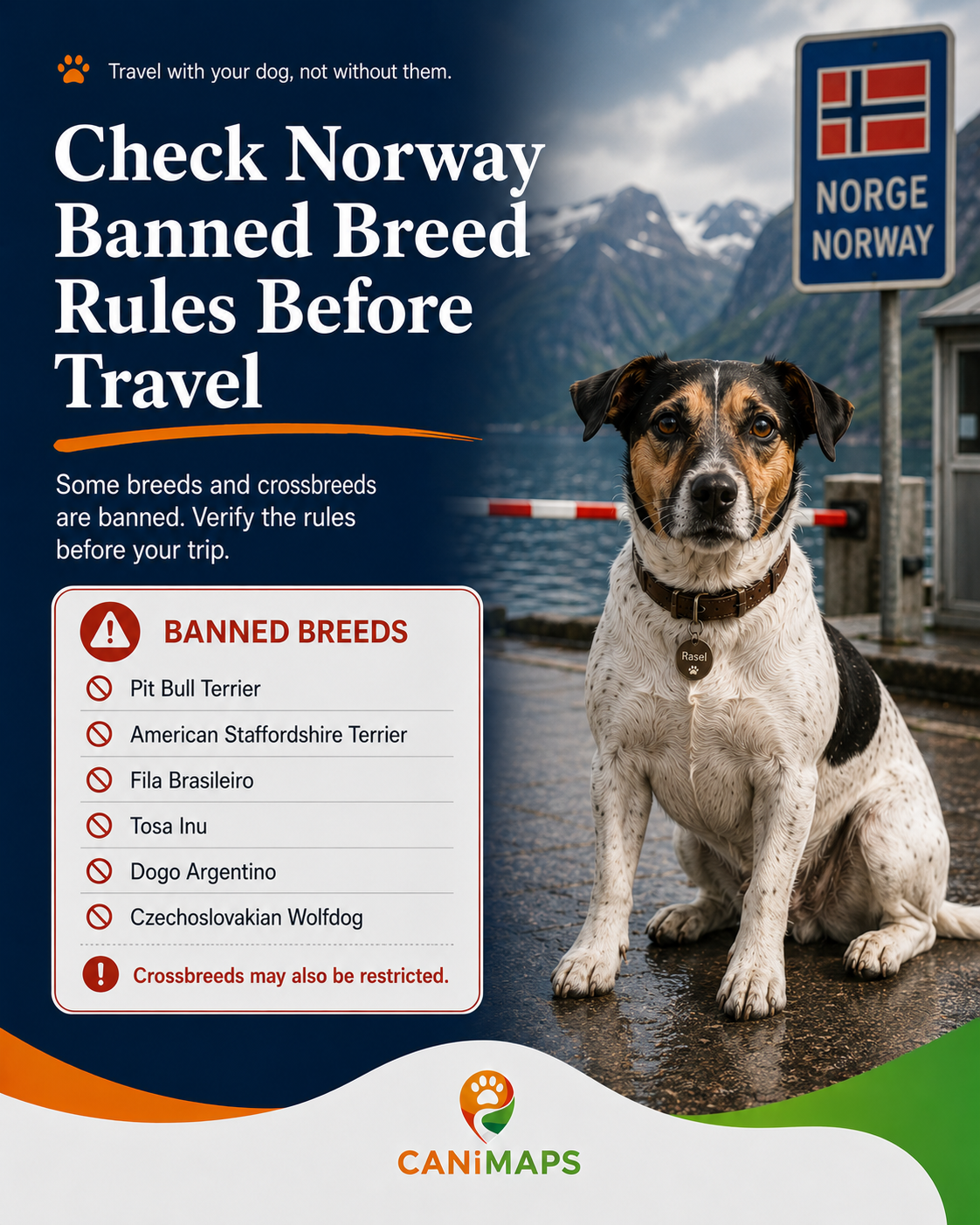
This is not the cute part of the article, but it matters.
Norway bans certain dog breeds. The Norwegian Food Safety Authority says the banned breeds are Pit Bull Terrier, American Staffordshire Terrier, Fila Brasileiro, Tosa Inu, Dogo Argentino and Czechoslovakian Wolfdog.
The ban also applies to crossbreeds where one or more of these breeds are present in any proportion, and wolf-dog hybrids are also considered dangerous.
This is serious.
If your dog could be affected by the breed rules, do not rely on social media comments, visual guesses or “but he is very friendly.” Contact the relevant Norwegian authorities before planning the trip.
A sweet dog can still be blocked by a legal breed rule.
That sentence is not fun, but it is better to know before the border.
Former Stray Dogs and Cats May Face Tougher Requirements
The Norwegian Food Safety Authority’s official pet travel guide warns that there are tough requirements for importing former stray dogs and cats to Norway.
This matters for rescue dogs.
If your dog was formerly a stray, or adopted through a rescue route, do not assume the standard tourist checklist is enough. Use the Norwegian Food Safety Authority guide and verify what applies to your specific dog before travel.
This is one of those cases where “probably fine” is not a plan.
Leash Season Inside Norway
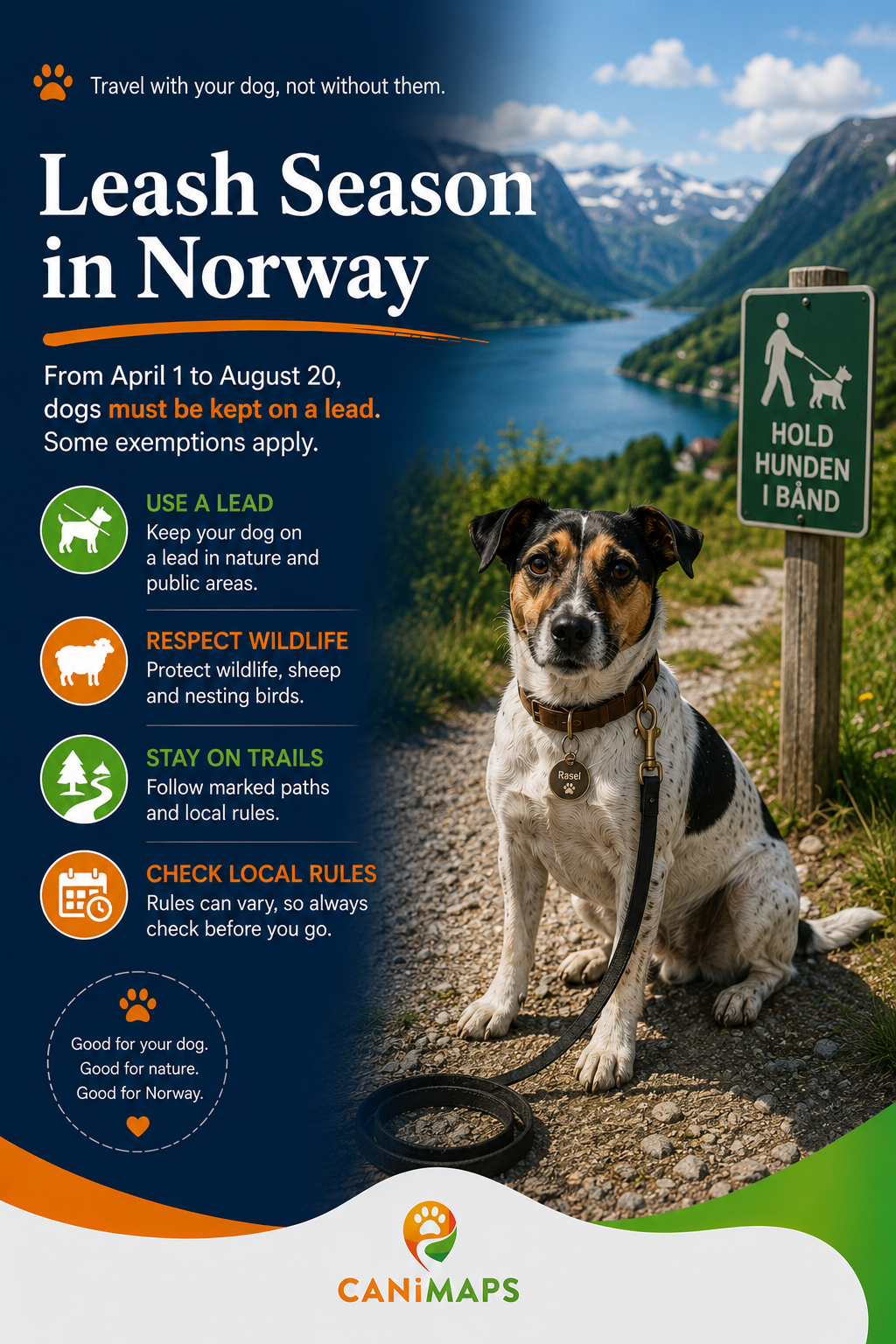
After you cross the border, the rules do not end.
Visit Norway says dogs must be kept on a lead from April 1 to August 20, with some exemptions.
That means your Norway dog trip needs two checklists:
Entry checklist: passport, rabies, microchip, tapeworm treatment and customs.
Inside Norway checklist: leash season, local rules, wildlife, sheep, national parks and accommodation rules.
Norway is not just scenery. It is scenery with sheep, wildlife and serious leash expectations.
Noodle: “The fjord invited me to sprint.”
Rasel: “The law did not.”
The CANIMAPS Norway Border Checklist
Before travelling to Norway with your dog, check:
Is your dog microchipped?
Is the pet passport valid?
Is the rabies vaccination valid?
Does your dog need tapeworm treatment?
Is the treatment booked 24–120 hours before arrival?
Has the vet recorded the treatment correctly?
Are you entering through the correct customs channel?
Are you travelling directly from Sweden, or from another route?
Is your dog affected by Norway’s breed restrictions?
Was your dog formerly a stray or rescue dog with extra requirements?
Are you travelling during leash season?
This sounds like a lot because it is a lot.
But the good news is that most of it is manageable if you plan backwards from the border crossing.
Final CANIMAPS Take
Norway can be incredible with a dog.
But it is not the country where you casually remember paperwork at the last petrol station.
The key rule is this:
For many dogs, Norway requires vet-administered tapeworm treatment 24–120 hours before arrival.
Put the arrival time in your calendar. Book the vet around it. Check customs rules. Bring the documents.
Then your dog can focus on the important work: staring at fjords like a tiny philosopher with paws.
Save this before your Norway trip, and follow CANIMAPS for more real-world dog travel tips across Europe.
FAQ
Does Norway require tapeworm treatment for dogs?
Yes, many dogs travelling to Norway need vet-administered treatment against fox dwarf tapeworm before arrival.
When must tapeworm treatment be done before entering Norway?
The treatment usually must be given by a veterinarian 24–120 hours before arrival in Norway and recorded correctly in the dog’s travel documents.
Is a pet passport enough to enter Norway with a dog?
Not always. A pet passport is important, but dogs may also need microchip identification, rabies vaccination, tapeworm treatment and customs presentation.
Do I need to use the red customs channel when entering Norway with a dog?
Usually yes. Travellers with pets normally need to use the red channel when entering Norway, except for some direct travel situations from Sweden.
Are dogs travelling directly from Sweden treated differently?
Sometimes. Norway has certain Sweden-related exceptions, but travellers still need to check their exact route, origin, documents and whether other rules apply.
What is Norway’s 28-day rule for dogs?
Frequent travellers may be able to use a continuous tapeworm treatment schedule with a maximum 28-day interval, but it must be correctly timed and documented by a veterinarian.
Does Norway have banned dog breeds?
Yes. Norway bans certain breeds and crossbreeds, including Pit Bull Terrier, American Staffordshire Terrier, Fila Brasileiro, Tosa Inu, Dogo Argentino and Czechoslovakian Wolfdog.
Do rescue dogs or former stray dogs need extra checks for Norway?
They may. Norway can apply tougher requirements for former stray dogs and cats, so owners should verify the exact rules before travelling.
Does Norway have a leash season?
Yes. Dogs generally must be kept on a lead from April 1 to August 20, with some exemptions and local rules.
What should I check before travelling to Norway with my dog?
Check microchip, pet passport, rabies vaccination, tapeworm treatment timing, customs channel, Sweden-route details, breed restrictions, former stray/rescue rules and leash season.

Europe Dog Travel Checklist and Top Dog Longevity Supplements
Get the Europe Dog Travel Checklist plus the free Top Dog Longevity Supplements e-book — travel smarter and support your dog’s long-term health.