
Why Some Dogs Suddenly Refuse Their Harness?

One day your dog sees the harness and loses all trust in civilization.
Yesterday:
“Walk?”
Immediate excitement.
Tiny paws.
Full happiness.
Today:
You pick up the harness and suddenly your dog becomes unavailable for comments.
Under the table.
Behind the sofa.
Suspicious.
Possibly considering legal action.
Owners often describe this as stubbornness or “being weird.” But dogs usually avoid harnesses for a reason. The problem may be physical discomfort, sound sensitivity, stressful walk associations, rough handling, bad fit, fear, or simply one unpleasant moment the dog decided never to forget.
And dogs are incredibly talented at remembering strange little betrayals.
Mistake 1: Assuming the dog is “just difficult”
This is the biggest one.
A dog that suddenly freezes, backs away or avoids the harness is communicating something. Even if the reason looks small to us, it may feel very important to the dog.
Sometimes owners continue exactly the same routine:
harness appears
dog avoids
human follows dog around apartment
harness eventually goes on anyway
walk happens under tension
That can accidentally teach the dog:
“The scary part always catches me eventually.”
Not ideal branding for the harness experience.
RSPCA guidance around fearful behaviour recommends avoiding punishment and allowing dogs choice where possible.
So instead of thinking:
“How do I stop this behaviour?”
Start with:
“What changed for my dog?”
Mistake 2: Turning harness time into a chase scene
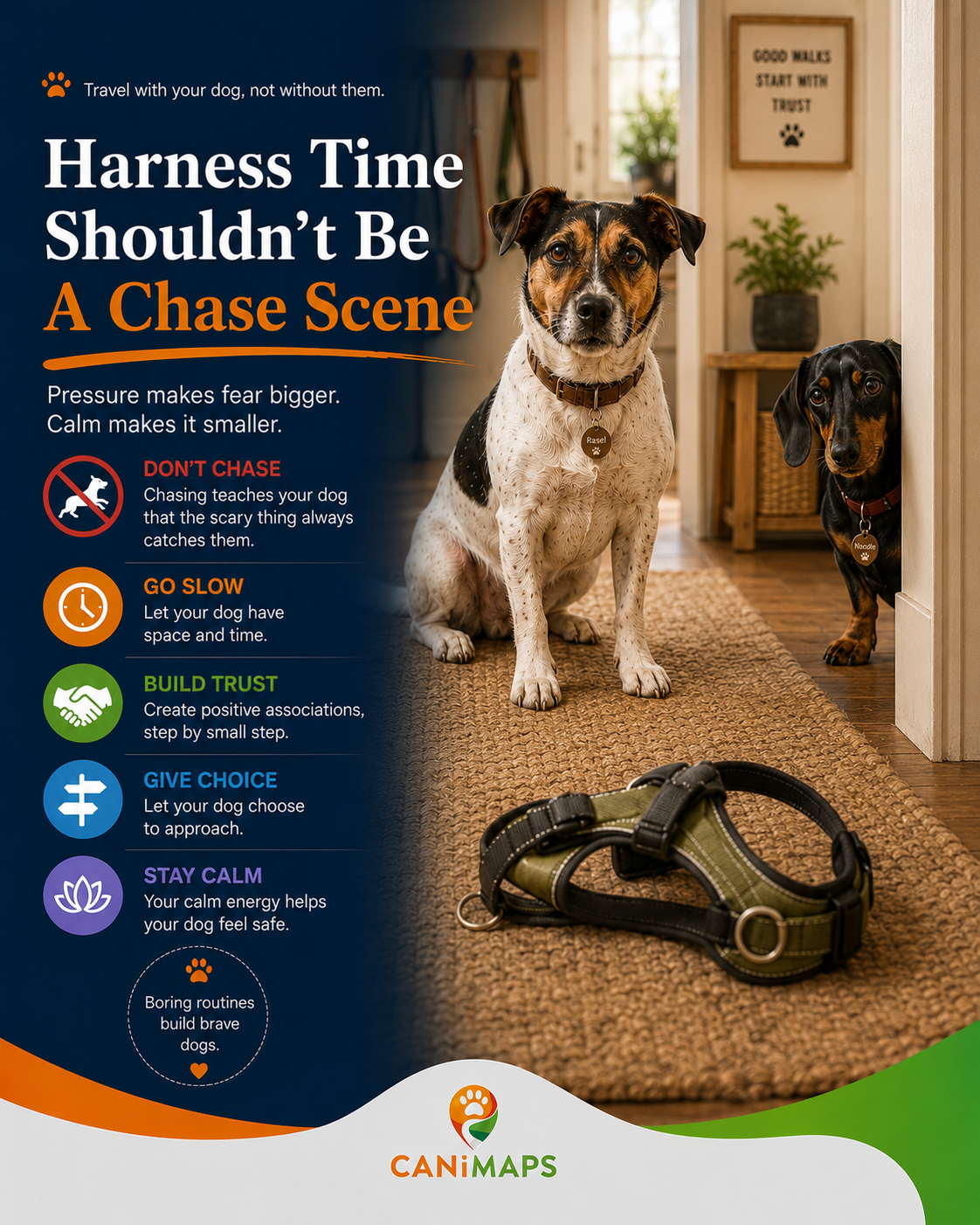
Many owners unintentionally make harness time chaotic.
The dog hesitates.
The owner speeds up.
The hallway becomes an action movie.
Now the harness predicts pressure, cornering and fast hands.
For sensitive dogs, that matters a lot.
Instead:
slow the routine down
put the harness down calmly
reward interest
avoid looming over the dog
avoid grabbing suddenly
let the dog approach voluntarily when possible
Blue Cross notes that forcing a dog into a harness can worsen fear and recommends creating positive associations gradually.
This does not mean your dog controls the entire household government now.
It means fear generally improves faster when the dog feels safer during the process.
Mistake 3: Ignoring fit and body discomfort
A harness can become uncomfortable without owners noticing immediately.
Possible reasons include:
rubbing under the legs
pressure around shoulders
sensitivity around the chest
weight gain or loss changing fit
matting under fur
skin irritation
pain unrelated to the harness
arthritis or soreness
a strap pinching during movement
VCA Hospitals notes that sudden behavioural changes or sensitivity to handling can sometimes be linked to pain or medical discomfort.
So if the behaviour appeared suddenly, especially in an older dog, do not automatically frame it as disobedience.
Watch for:
stiffness
limping
sensitivity when touched
reluctance to move
unusual posture
reduced enthusiasm for walks
licking one area repeatedly
If something feels physically off, speak to your vet before turning the issue into a “training battle.”
The harness may not be the real problem. It may simply be where the dog notices discomfort most clearly.
Mistake 4: Forgetting that sounds matter

Humans often underestimate tiny sounds.
But some dogs absolutely notice:
metal clips
Velcro ripping
stiff buckles
tags hitting hardware
sudden snapping sounds
Especially if the sound once happened near the dog’s face or body.
A single unpleasant surprise can create a weird little fear ritual.
Noodle would absolutely decide:
“Metal click = emotional danger.”
Rasel would file a formal safety review.
If your dog startles during clipping:
slow down
separate the sound from the rush
reward calm behaviour
practice clipping sounds away from walk excitement
avoid clipping directly beside the dog’s ears
Tiny details matter more than owners think.
Mistake 5: The harness only predicts stressful events
Sometimes the harness itself becomes associated with things the dog dislikes.
Examples:
crowded streets
noisy cafés
vet visits
rushed toilet breaks
chaotic dog parks
long car rides
uncomfortable weather
overexciting walks
scary traffic
The dog may not hate the harness itself.
The harness may simply mean:
“Oh no. That thing again.”
This is especially common in dogs that are:
sensitive
recently rescued
easily overstimulated
recovering from bad experiences
naturally cautious
going through adolescence
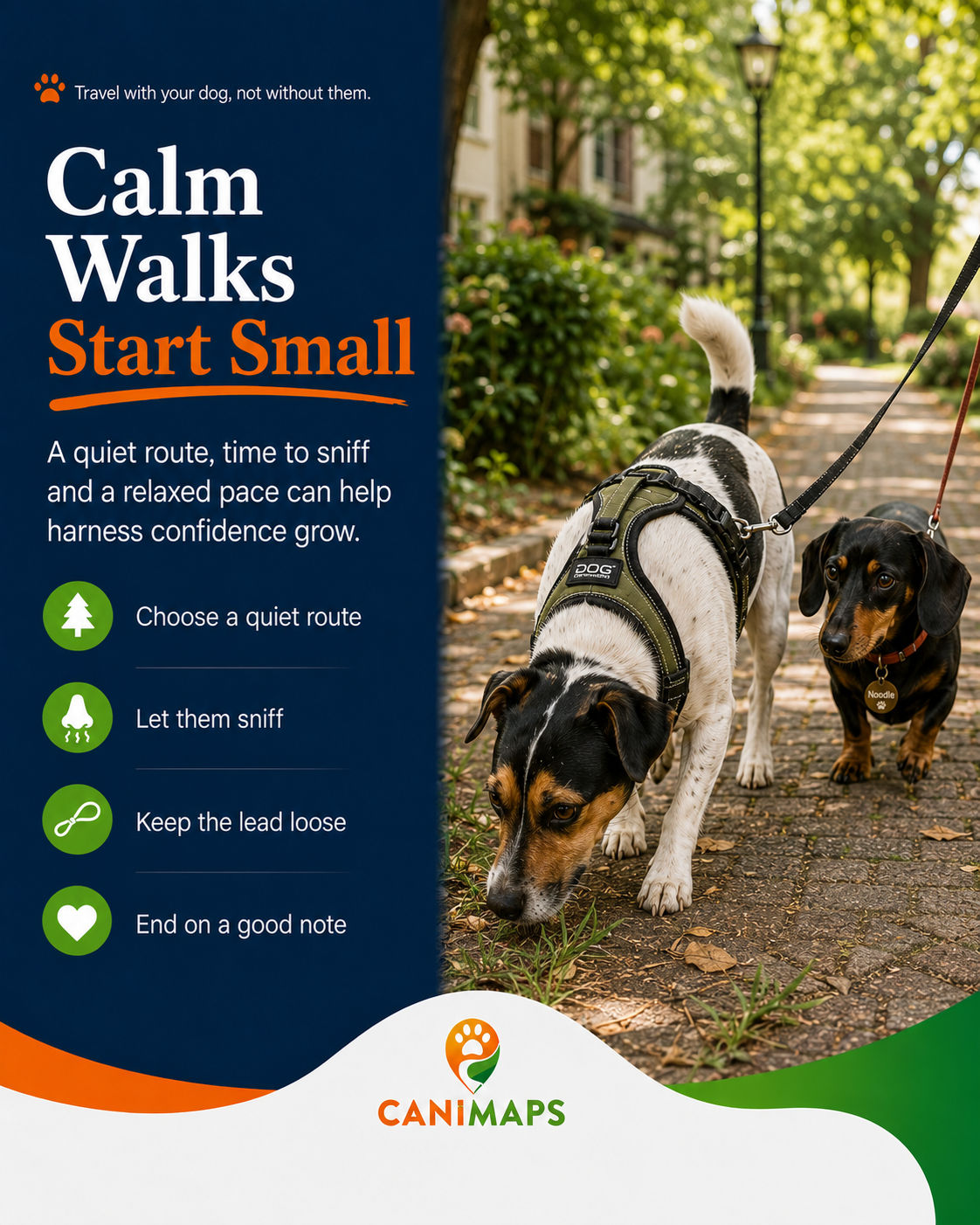
Try rebuilding neutral or positive associations:
short calm walks
sniff-focused walks
reward quiet behaviour
put the harness on briefly indoors
remove pressure around “perfect walking”
avoid stacking stressful situations together
Not every walk needs to become a productivity seminar.
Some dogs genuinely need calmer outings for confidence.
What calm harness routines usually look like

The best harness routines often look very boring.
And boring is excellent.
The dog sees the harness.
No one panics.
No one chases anyone.
No dramatic hallway negotiations occur.
The harness appears calmly.
The dog approaches voluntarily.
The owner moves slowly.
The walk starts without tension.
That is the goal.
Not:
“Fastest harness application in the western hemisphere.”
The 3-minute reset exercise

Try this once daily for a few days:
Put the harness on the floor.
Let the dog notice it.
Reward calm curiosity.
Pick it up calmly.
Reward again.
Touch briefly without clipping.
End session before stress rises.
No forced walk required.
The point is to disconnect:
“Harness appears = stress immediately follows.”
Sometimes owners try to fix everything in one giant training session.
But confidence usually returns through many small boring wins.
And honestly, boring wins are underrated in dog life.