
Croatia National Parks With a Dog: What to Check Before the Waterfall Selfie
Croatia with a dog sounds like a perfect plan.
Waterfalls. Lakes. Stone paths. Mountain trails. Your dog looking heroic in the breeze. You looking like someone who definitely remembered water, snacks and the leash.
Then the national park happens.
A sign says dogs must stay on leash.
A boat route has restrictions.
An island says no dogs.
The boardwalk is narrow.
The lake is gorgeous, but swimming is not allowed.
Suddenly your dream hike has paperwork energy.
Croatia can be a brilliant country to explore with a dog, but national parks are not the same as normal walking routes. They are protected areas, and the rules can be specific. The smart move is to check the exact park, exact route and exact dog restriction before you go.
The big mistake: “dogs allowed” does not mean “dogs can go everywhere”
This is the classic dog-travel trap.
A park may allow dogs, but only on a leash.
A park may allow dogs on trails, but not on an island.
A park may allow dogs near waterfalls, but not in the water.
A park may allow dogs generally, but the crowds and boardwalks may make it miserable for nervous dogs.
So the useful question is not only:
“Are dogs allowed?”
The useful question is:
“Where exactly can my dog go inside the park, and what are the restrictions?”
That one question can save your day.
And possibly your dog’s dramatic attempt to befriend a waterfall.
Plitvice Lakes with a dog: beautiful, busy and not off-leash
Plitvice Lakes National Park is one of Croatia’s most famous natural attractions. It is also a place where dog owners need to be realistic.
The official Plitvice rules include “Don’t walk dogs unleashed.” The same rules also say not to swim in the National Park zone.
That means two things.
First, your dog should stay on leash. Second, the lakes are for admiring, not for spontaneous dog mermaid behaviour.
This matters because Plitvice is not just a big open park. It has wooden paths, lake edges, viewpoints, steps and heavy visitor traffic in popular periods. Even if your dog is allowed, the experience may be very different depending on your dog’s temperament.
A calm dog who can handle crowds, narrow paths and waiting may do well.
A dog who thinks every bridge is a personal agility course may create a small international incident.
Noodle would call it “interactive hiking.”
Rasel would call it “why we cannot have nice things.”
Krka National Park with a dog: leash yes, Visovac Island no
Krka National Park is another major Croatia waterfall destination, and its dog rules are more specific than a simple “yes.”
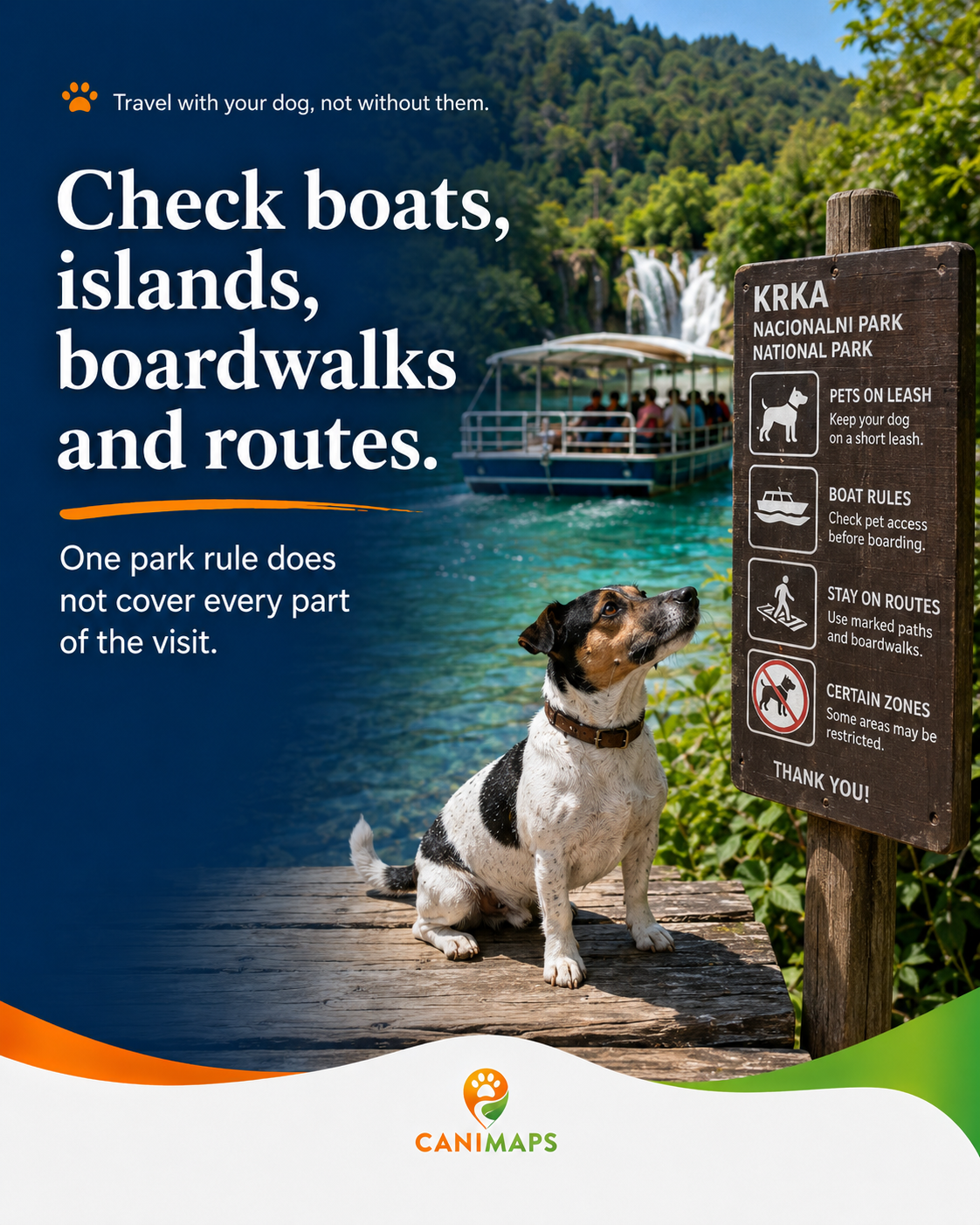
Krka’s official FAQ says dogs are permitted in the park when accompanied by their owners and must be on a leash at all times. It also says dogs are not permitted on Visovac Island.
The park rules repeat the same leash requirement and Visovac Island restriction. They also say visitors must not walk outside marked walking trails and visitor areas.
This is exactly why dog owners need to check route details.
You might be able to visit parts of the park with your dog. But if your plan includes a specific island, boat connection or route, you need to verify whether dogs can join that exact part.
“Dogs allowed in the park” is not the same as “dogs allowed on every park experience.”
This is the sentence to tattoo on your travel plan. Temporarily, ideally.
Paklenica National Park with a dog: hiking rules still apply
Paklenica is a different kind of Croatia national park experience. Instead of lake boardwalks and waterfall crowds, think canyons, mountain paths, climbing areas and serious hiking energy.
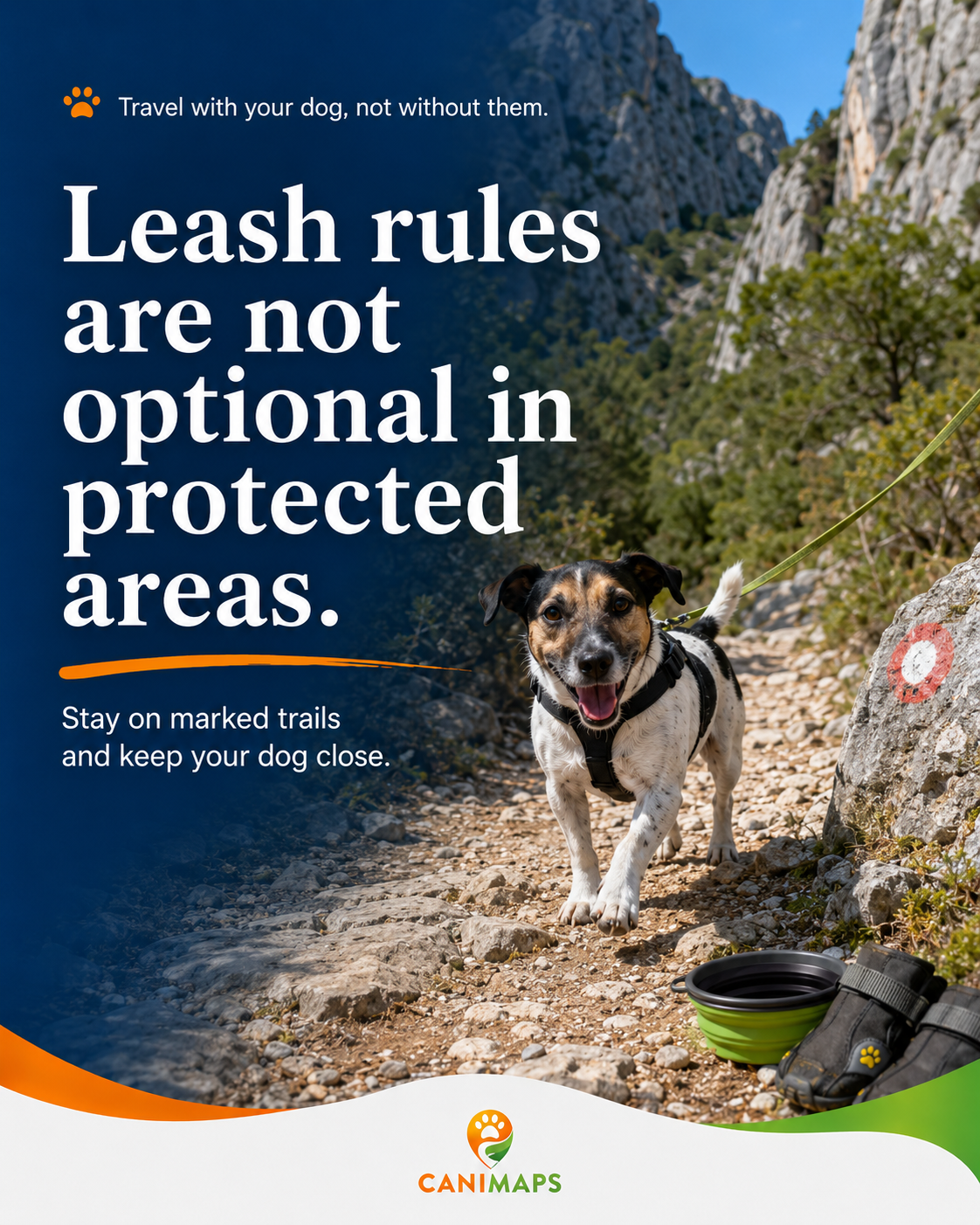
The official Paklenica FAQ says pets are allowed, but they cannot move around freely and must be kept on a leash to avoid disturbing wild animals and other visitors.
Paklenica’s code of conduct also says to keep your dog on a leash and not to walk outside marked trails.
This is important because mountain parks can look more “open,” but that does not mean off-leash is okay. Protected wildlife areas are not dog playgrounds. Even a friendly dog can disturb animals, other hikers or climbers.
Also, Croatia’s rocky trails can be hard on paws. Hot stone plus excited dog equals one unhappy travel companion.
Your dog did not come to Croatia to become toast.
Check boats, shuttles and islands separately
This is where many dog owners get caught.
In some national parks, the visit is not only a walk. It may include boats, electric boats, shuttle buses, visitor routes, bridges or islands.
The dog rule for the park entrance may not answer every practical question.
Before you go, check:
Can dogs enter the park?
Can dogs use the park boat?
Can dogs use the shuttle bus?
Are muzzles required on transport?
Are dogs allowed on islands?
Are dogs allowed on all marked trails?
Are there boardwalk sections that may be too narrow or crowded?
Are there heat or shade issues?
Can the dog swim?
Are there seasonal route closures?
This is the CANIMAPS difference between “sounds dog-friendly” and “actually works with your dog.”
No swimming usually means no swimming
Croatia’s lakes and waterfalls can be painfully tempting.
Your dog may look at the water.
You may look at your dog.
Your dog may look back with the face of a creature who has already made a decision.
But protected park water is not the place to improvise.
Plitvice’s official rules state not to swim in the National Park zone. Krka’s official rules say visitors must stay on marked trails and visitor areas, and dogs must be leashed at all times.
For dog owners, the safe assumption is simple: unless the park clearly says dogs may enter the water in a specific place, do not let your dog swim.
A waterfall selfie is optional.
A park fine, a stressed dog or damaged protected habitat is not.
Bring the boring things
A successful dog day in a Croatian national park is mostly built from boring items.

Bring:
short leash
water for your dog
collapsible bowl
poop bags
muzzle if transport rules require it
pet passport or travel documents
paw protection or paw balm
cooling towel
snacks
route map
backup plan
The backup plan matters. If your dog gets overwhelmed by crowds, heat or narrow boardwalks, you need a graceful exit that does not involve carrying a furious terrier through a UNESCO-level crowd.
Rasel would leave early with dignity.
Noodle would be carried like a baguette.
Do not forget EU pet travel paperwork
Park rules are separate from border rules.
If you are travelling to Croatia from another EU country, your dog still needs the correct pet travel documents. EU guidance says a European pet passport for a dog, cat or ferret can be issued by an authorised vet and remains valid as long as the health information, such as rabies vaccination, remains valid.
Croatia’s government portal also explains pet travel requirements and notes that, for pets from the EU, a rabies antibody titer test certificate is not necessary, although relevant information must be entered in the pet passport where applicable.
This does not mean a ranger at a waterfall will ask for your dog’s passport. It means your Croatia trip should be legal before you even reach the park gate.
Your dog can be perfectly documented and still not allowed on a specific island.
Travel is humbling like that.
Best type of dog for Croatian national parks
This is not about breed. It is about personality.
Croatian national parks are best for dogs who can handle:
staying on leash
passing people calmly
waiting on narrow paths
not pulling toward water
ignoring wildlife
walking on stone or wooden surfaces
heat management
changing plans
They may be harder for dogs who are reactive, heat-sensitive, elderly, injured, very young, or obsessed with swimming.
That does not mean you should not go. It means choose the right park, right route and right time of day.
Early starts are your friend. Shade is your friend. Water is your friend.
Midday crowds are not your friend. They are a very sweaty group project.
The CANIMAPS Croatia national park rule
Before visiting a Croatian national park with your dog, check five things:
Exact park.
Exact route.
Leash rule.
Transport or island restrictions.
Water and swimming rules.
That is the practical core.
Do not rely on one sentence saying “dogs allowed.” In national parks, that sentence is only the beginning. The real answer lives in the details.
Croatia can be incredible with a dog. Just make sure your waterfall day is planned around rules, heat, crowds and your dog’s actual personality.
Because the best travel memory is not “remember when Noodle tried to board the forbidden island boat?”
Actually, Rasel says that was educational.
Save this guide before your Croatia trip, and follow CANIMAPS for real-world dog travel tips across Europe.